

Trust grows through the way partners respond to one another: keeping an agreement, listening to a correction, respecting a private detail and returning to a difficult conversation. In an LGBTQ+ relationship, those ordinary moments may sit alongside questions about family, identity, belonging or who knows about the relationship.
There is no single LGBTQ+ relationship experience. Start with what each of you needs and what is happening between you, rather than assuming that one explanation fits every disagreement.
Make trust specific
“I want to trust you more” can mean several things. You may need more reliable plans, honesty about a broken agreement, privacy around your identity or reassurance that your partner will respond when a family member is disrespectful. Naming the concern makes it easier to discuss a possible change.
Try this: “When our plans change and I do not hear from you, I feel left out. Could we agree to send a short update?” That gives the other person something clear to respond to. It also leaves room to discuss what is realistic, rather than asking for constant availability.
Four habits that make a conversation clearer
1. Describe the event
Use a concrete example. “You shared our photo in the family group” is clearer than “You never respect me.”
2. Name your experience
Say what you felt and needed without claiming to know the other person’s hidden intention.
3. Listen for the difference
Ask what the situation meant to your partner. Understanding their account does not require agreeing with every action.
4. Make one agreement
Choose something both people freely accept, then decide how you will check whether it is working.

Discuss privacy, identity and coming out
Partners may be open about their identity in different settings. Ask before sharing photographs, labels, personal history or relationship details with family, colleagues or social groups. What seems like an ordinary post to one person may disclose something the other person has not chosen to share.
A useful conversation separates several questions: who may know, what may be shared, which words feel right and what practical concerns exist. Each person should have a say in their own disclosure. Do not pressure a partner to come out or assume silence means they care less.
Your need to feel acknowledged also matters. You can talk about what different levels of openness mean for your life together and whether an arrangement meets both people’s needs. If that difference is hard to navigate, consider support that respects identity, autonomy and safety.
Respond to outside pressure as a team
Family rejection, a hostile remark or an unwelcoming environment can affect partners differently. Before offering a solution, ask: “Would you like me to listen, say something, help make a plan or give you space?” Do not require someone to defend every reaction or educate everyone around them.
Agree on practical options for situations you expect, such as how long to stay at a family gathering or how to support each other if a comment crosses a line. Where it is safe, you might choose a shared phrase for leaving a conversation. A plan should remain flexible and should not make one partner responsible for managing everyone else’s behavior.
Build closeness with boundaries
Trust and privacy can coexist. Password sharing, constant location access or immediate replies are not automatic requirements for commitment. Discuss which information is relevant to your actual relationship agreements, what each person consents to share and what remains private.
Love is respect’s boundaries guide explains how limits reflect needs and comfort. A healthy boundary describes your own choices; it should not become a rule that controls a partner’s friendships, identity or access to support.
For broader relationship language, explore our guide to partner qualities. If a conversation involves affection or sex, the physical-intimacy guide offers a starting point for discussing comfort and consent.
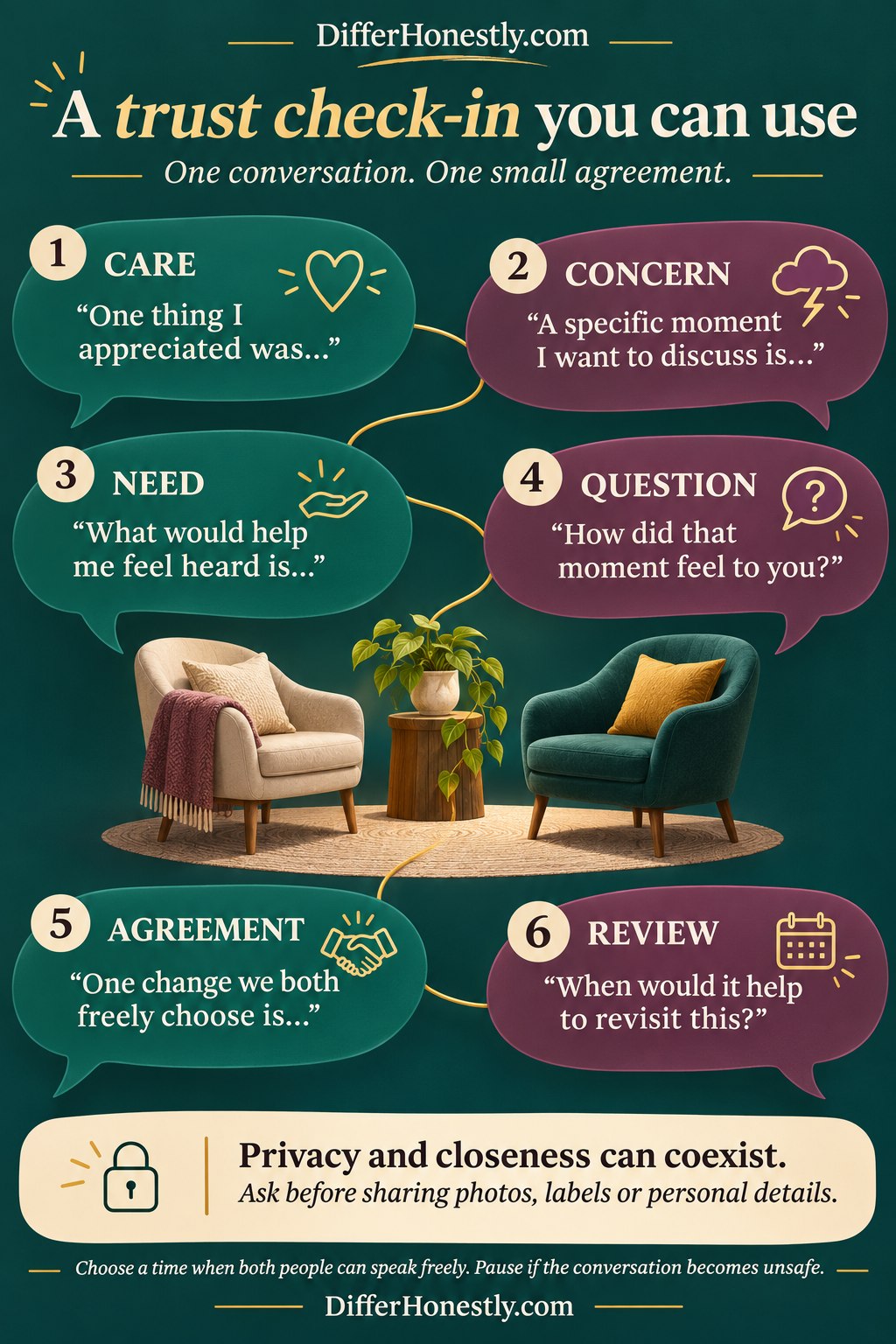
Free trust check-in sheet
Use these prompts when both people can speak freely. You can answer separately first, choose one topic or stop if the conversation is not useful.
- One moment of care: What helped me feel respected recently?
- One concern: What specific event or pattern would I like to discuss?
- One need: Do I need reliability, privacy, support, space or a clearer agreement?
- One question: What do I want to understand about my partner’s experience?
- One shared experiment: What small change do we both freely want to try?
- One review point: When will we check how it felt and whether to adjust it?
Example: “I appreciated you checking before posting our photo. I am worried about the upcoming family visit. Could we discuss what we are comfortable sharing and how we want to support each other?”
When trust has been damaged
An apology is a beginning, not a substitute for changed behavior. Name the broken agreement, take responsibility for your part and discuss what follow-through would look like. The person who was hurt does not owe immediate forgiveness or a timetable for renewed trust.
If a disagreement becomes too heated, pause and agree on a realistic time to return when it is safe to do so. Avoid using a break as punishment or leaving the topic permanently unresolved. One person’s willingness cannot do the work for both.
Consider affirming support when you need it
Couples therapy can offer a place to examine recurring patterns and define goals, though it cannot guarantee a relationship outcome. Our guide to choosing affirming couples therapy includes questions about experience, confidentiality and fees.
If faith or spirituality matters to either of you, you can include it in the discussion without using a spiritual interpretation to decide what the other person feels. Ask for support that respects both identity and belief.
Let trust show up in ordinary actions
Choose a manageable agreement and pay attention to what actually changes. Trust does not require a perfect conversation; it asks for honesty, respect and follow-through that both people can experience over time.
Frequently asked questions
1. How do we start building trust?
Choose one specific concern and one realistic agreement. Notice follow-through over time rather than asking one conversation to settle everything.
2. Are LGBTQ+ relationships all affected by the same issues?
No. Identity, culture, family, finances, disability, faith and personal history can matter differently to each relationship. Ask about each person's actual experience.
3. How do I ask for reassurance without demanding constant contact?
Describe the situation and the reassurance you want, then discuss what is realistic for both people. A short update about changed plans may be more workable than a requirement to be available all day.
4. What if my partner is not out to family?
Ask about their privacy choices and practical concerns without forcing disclosure. You can also discuss your own need for acknowledgment and whether a shared arrangement works for both of you.
5. Should we ask before posting relationship photographs?
Agree on what may be posted, where and for which audience. A photograph or tag can disclose identity or relationship information someone has not chosen to share.
6. Does trust mean sharing passwords?
No. Partners can keep privacy while honoring agreed relationship commitments. Access to an account should not be demanded as proof of love.
7. How do we talk about discrimination or family rejection?
Ask what kind of support is wanted, listen without minimizing and discuss practical options together. Do not assume the same event affects both partners in the same way.
8. Can we disagree and still trust each other?
Yes. Respectful disagreement can include listening, asking questions and accepting a limit. Trust does not require identical opinions or agreeing to every request.
9. What is a useful I statement?
Name a specific event, your feeling and a request: “When plans changed without an update, I felt left out. Could we agree to let each other know?” Avoid disguising an accusation as a feeling.
10. How can we pause an argument?
If it is safe, say that you need a break and agree on a reasonable time to return. A pause should support a later conversation rather than punish the other person.
11. Does an apology mean trust is restored?
No. An apology can begin a repair, but trust also depends on changed behavior and freely chosen boundaries. Forgiveness cannot be demanded.
12. Can one person rebuild the relationship alone?
One person can work on their own conduct and seek support, but cannot make the other person participate honestly or change.
13. When might affirming couples therapy be useful?
You can seek help with recurring conflict, different expectations or a change you find difficult to navigate. Ask about the clinician's experience, approach, goals and practical terms.
14. Should we use a communication worksheet if there is abuse?
Not as a reason to confront an abusive partner. Coercion, violence or fear of retaliation calls for confidential individual support and safety planning suited to the situation.
15. How do we know a check-in helped?
Look for a clearer understanding or a small agreement both people accept, then observe actual follow-through. You can adjust the format or seek support if it is not useful.