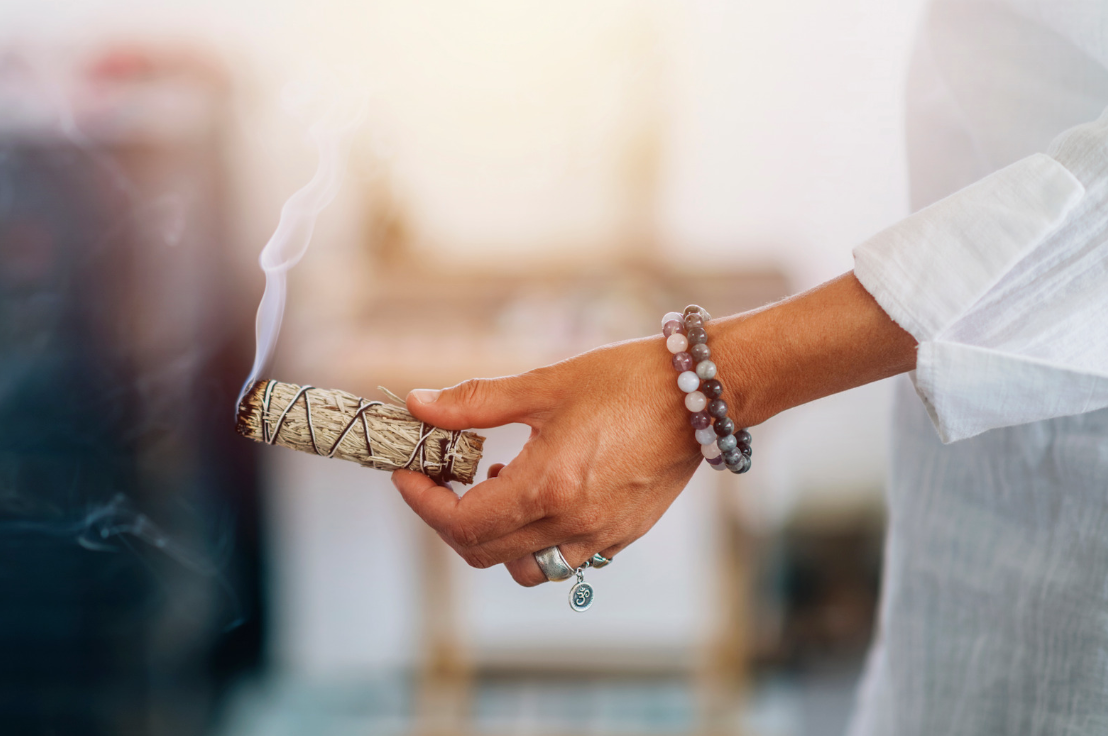
“Smudging” is often used online as a catch-all term for burning plants to change the feeling of a room. That shortcut misses important context. Smudging can refer to specific Indigenous ceremonial traditions with their own medicines, prayers, protocols, and community teachings. It is not one universal “ancient ritual,” and there is no single recipe that belongs to every Nation or culture.
The Government of Canada’s conservation guidance describes smudging as a culturally sensitive ceremonial practice involving smoke from plant materials such as sweetgrass, tobacco, or sage in particular Indigenous contexts. If you are participating in an Indigenous ceremony, follow the guidance of the Elder, knowledge keeper, or community hosting it. If you are creating a personal non-Indigenous home ritual, “smoke cleansing” or “home-clearing ritual” may be a clearer description.
What a cleansing ritual can—and cannot—do
A ritual can mark a transition, focus attention, support reflection, or help a space feel intentional. Some people spiritually interpret that change as clearing negative energy. That is a belief, not a measurable guarantee. Smoke does not remove conflict, mold, carbon monoxide, infection, trauma, or other physical and social hazards.
Pair symbolic action with practical action. Open a conversation, clean a spill, repair a smoke alarm, improve ventilation, seek qualified help, or leave an unsafe situation when that is what the problem requires.
Smoke has real health and fire risks
Burning plant material creates airborne particles. The U.S. Environmental Protection Agency’s indoor particulate guidance notes that burning almost anything produces particulate matter and that ventilation is important when candles or incense are burned indoors.
Avoid smoke cleansing when anyone present has asthma, COPD, smoke sensitivity, respiratory illness, or another condition that may be aggravated. Consider children, pets, neighbors, roommates, and building rules. Never assume that “natural” smoke is harmless. A smoke-free ritual is the safer choice whenever you are uncertain.
Before using any flame
- Check local fire restrictions, tenancy rules, smoke alarms, and building policies.
- Ask everyone sharing the space for consent.
- Open a window if outdoor air quality allows, and keep the session brief.
- Use a stable, heat-resistant container on a clear, nonflammable surface.
- Keep water or another appropriate extinguishing method within reach.
- Keep flame and embers away from curtains, paper, clothing, hair, children, and animals.
- Never leave burning material unattended or carry a smoldering bundle through clutter.
- Extinguish it completely and confirm that no ember remains before disposal.
Do not blow forcefully on embers or try to fill every corner with dense smoke. More smoke is not more effective; it is simply more exposure.
Choose materials with care
Sage, cedar, sweetgrass, and tobacco can be sacred medicines within particular Indigenous traditions. Their meanings and protocols are not interchangeable. Palo santo belongs to distinct cultural and ecological contexts as well. Avoid marketing that treats these plants as generic spiritual commodities or promises guaranteed purification.
If you purchase plant material, ask who grew or gathered it, whether harvesting was lawful and sustainable, and whether the seller has a genuine relationship with the community or tradition it references. Do not harvest plants from private, protected, or public land without permission and reliable identification. Never burn an unidentified plant, treated wood, synthetic fragrance, or material that may be toxic.
A shell, feather, crystal, or four-element arrangement is not required for a safe personal ritual. Do not present one culture’s sacred items as universal accessories. A simple ceramic dish and a clear intention can be enough for a non-ceremonial reflection practice.
A simple, respectful smoke-cleansing routine
- Name the purpose. Choose a concrete intention such as “I am marking the end of a difficult week” or “I want this room to feel calmer.” If you need help choosing, try clarifying what you want.
- Prepare the space. Remove fire hazards, arrange ventilation, ask for consent, and keep an extinguishing method ready.
- Use the smallest amount. Light only enough to create a brief ember, then extinguish the flame. Do not deliberately inhale or fan smoke toward faces.
- Stay in one safe place. Rather than walking through the entire home, keep the heat-resistant container stable and let the reflective pause be the focus.
- Close deliberately. Extinguish everything fully, ventilate, and complete one practical action connected to your intention.
Smoke-free alternatives
You can create the same pause without combustion:
- open curtains or a window when conditions are safe;
- tidy one small surface;
- ring a bell, clap, hum, or play quiet music;
- wash your hands or face as a transition ritual;
- place a meaningful object where you will see it;
- write down what you are releasing and what you are choosing;
- take a brief, comfortable breathing or mindfulness pause.
Our guide to making your day better with mindfulness offers a gentle smoke-free option. These actions do not prove that energy changed; they make the desired transition visible and memorable.
Final thoughts
Smudging deserves cultural specificity and respect. Personal smoke-cleansing rituals can be meaningful, but they should be described honestly, practiced with consent, and kept secondary to health and fire safety. When smoke is unsuitable, a quiet, smoke-free ritual can carry the same reflective intention.
Frequently Asked Questions
Is smudging the same in every Indigenous culture?
No. Practices, medicines, prayers, permissions, and meanings vary among Nations and communities. Follow the guidance of the community hosting a ceremony rather than treating smudging as a universal recipe.
Does smudging scientifically remove negative energy?
There is no established scientific measure showing that smoke removes spiritual negativity. A ritual may still feel meaningful as reflection or transition, but practical hazards and conflicts need practical responses.
Is burning sage or other herbs indoors safe?
Burning plant material creates particulate matter and carries fire risk. Avoid it around respiratory vulnerability, children, pets, or anyone who does not consent, and follow ventilation, building, and fire-safety rules.
What can I do if I cannot use smoke?
Try light, sound, cleaning one small area, journaling, washing, arranging a meaningful object, or a brief mindfulness practice. The intention and practical follow-through can matter more than smoke.